“Recite what has been revealed to you of the Book and establish prayer. Indeed, prayer prohibits immorality and wrongdoing, and the remembrance of Allah is greater. And Allah knows that which you do.”
Quran 29:45
What is Jihad?

The Arabic word jihad means to strive. Jihad is generally divided into two forms: the greater jihad and the lesser jihad.
The greater jihad is an internal struggle to be pious and good. The Prophet (sawa) is reported to have said: “The greatest jihad is the jihad against your own evil desires.” It is incumbent upon us to strive in the cause of Allah to better our surroundings and ourselves.
The lesser jihad is an external struggle, or defense, in protection of Islam and Muslims. It is obligatory for us to defend our religion when it is in danger, but we should never be the aggressors.
Let us take a look at what the Quran says about the severity of killing a person unjustly.
“Whosoever kills a human being for other than manslaughter or corruption in the earth, it shall be as if he had killed all mankind, and whoever saves the life of one, it shall be as if he had saved the life of all mankind.”
Let us also look at this hadith related by Imam al-Sadiq (as) about the rules and precautions of war
“The Messenger of Allah (sawa), when he wanted to send out troops, called them and bid them to sit before him. He then said to them: Go out in the name of Allah and by Allah and in the way of Allah and according to the religion of the Messenger of Allah. Do not handcuff or tie up (the prisoners of war), do not mutilate (even the dead), and do not betray people. Do not kill the old man, the child or the woman, and do not cut down a single tree except when you are forced to do so. And if any Muslim be he lofty or lowly gives a man of the Polytheists sanctuary, then his safety must be secured so that he hears the word of Allah. If he follows you then he is your brother in religion. If he refuses then give him his sanctuary and seek the help of Allah regarding him.”
Allah says in the Noble Quran “And if any one of the polytheists seeks your protection, then grant him protection so that he may hear the words of Allah. Then deliver him to his place of safety. That is because they are a people who do not know.”
War, Peace and Non-Violence author, Ayatollah Sayed Muhammad Shirazi, writes of the Prophet’s peaceful methods:
The Messenger of Allah, Muhammad (sawa), progressed, as we have said, through peace that he adopted as his formula. One example of this is Mecca, the capital of unbelief and idolatry and the capital of waging war against the Messenger of Allah (sawa). The people of Mecca confronted the Messenger of Allah by every possible means. They banished him, killed his (foster) daughter Zaynab, confiscated his wealth and killed many of his followers. Finally they tried to assassinate him so he fled secretly to Madina but they continued their plots against his holy mission. Despite this, after more than twenty years, when the Messenger (sawa) wanted to conquer Mecca, he made preparations then proceeded to conquer that city peacefully without one drop of blood being spilt. Among the preparations he made were when he took possession of Khaibar, he took as spoils a large hoard of golden vessels as many as twenty thousand in number and of differing sizes. The Messenger (sawa) sent a number of these vessels to be shared out amongst the poor of Mecca even though they were unbelievers, polytheists, and warring against the Messenger of Allah (sawa). When these golden vessels arrived for the people of Mecca, they were confused and amazed. They said: ‘We fight this man, we confiscate his property, we kill his followers and his relatives and he deals with us in such a kind manner.’
This was an overture from the Messenger of Allah (sawa) to bring Islam to Mecca and to destroy the idols and to establish peace between the people. When the Messenger of Allah (sawa) conquered Mecca, Abu Sufyan, his archenemy came and the Messenger of Allah (sawa) pardoned him. Not only this but he made his house a sanctuary saying: ‘Whoever enters the house of Abu Sufyan is safe.’ Then he turned to, the wife of Abu Sufyan, Hind the woman famous for her immoral acts and attacks on the Messenger of Allah (sawa). She who had torn open the abdomen of Master of the Martyrs Hamza, and amputated his ears and his nose and mutilated him in the vilest manner, taking out his liver and chewing it in her mouth. This woman, this ‘war criminal’ was sent by the Messenger of Allah a document of pardon. By this, the Messenger of Allah (sawa) recorded the most magnificent example in the history of creation of forgiveness even of his most ardent enemies.
The chroniclers report that Mecca at this time was the capital of unbelief and Polytheism, hypocrisy, selfishness and pride. When it surrendered to the Messenger of Allah (sawa), most of the people did not announce their entry into Islam but rather remained on the way of Polytheism. The Messenger of Allah (sawa) did not coerce them to accept Islam ever but instead left them to themselves so that they would live by themselves under the rule of Islam to enter Islam in the future.
As the Quran states “There shall be no compulsion in [acceptance of] the religion.”
So as we can see, our Holy Prophet (sawa) and his family were never the aggressors. They defended their religion by performing Jihad when they were attacked, but they would always strive to resolve matters peacefully. When forced to perform Jihad there were very strict rules and regulations to insure that the Muslims did not over step the boundaries.
Excerpt from Mystery of the Shia by Mateen J. Charbonneau Available at:
http://www.amazon.com/s/ref=nb_sb_noss_1?url=search-alias%3Daps&field-keywords=mateen+charbonneau&rh=i%3Aaps%2Ck%3Amateen+charbonneau
The Word Shia and its Meaning from Sunni sources

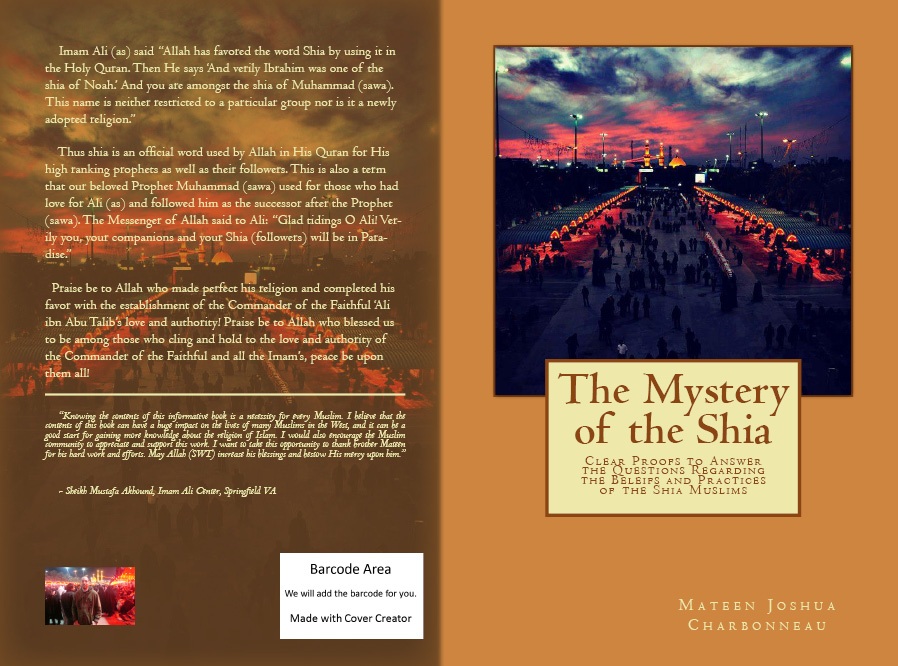
The term Shia literally means follower. It is a term that Allah used in the Quran to refer to the followers of his Prophets. An example was Prophet Abraham (as) who was mentioned in the Quran specifically as the shia of Noah (as):
“And most surely Abraham was among the Shia of him (Noah)” (Quran 37:83)
Imam Ali (as) said “Allah has favored the word Shia by using it in the Holy Quran. Then verily He says ‘And verily Ibrahim was one of the shia of Noah.’ And you are amongst the shia of Muhammad (sawa). This name is neither restricted to a particular group nor is it a newly adopted religion.” [1]
In another verse, the Quran talks about the Shia of Moses
“And he (Moses) went into the city at a time when people (of the city) were not watching, so he found therein two men fighting, one being of his shia and the other being his enemy, and the one who was of his shia cried out to him for help against the one who was of his enemy” (Quran 28:15)
Thus shia is an official word used by Allah in His Quran for His high ranking prophets as well as their followers. This is also a term that our beloved Prophet Muhammad (sawa) used for those who had love for Ali (as) and followed him as the successor after the Prophet (sawa).
The Messenger of Allah said to Ali: “Glad tidings O Ali! Verily you, your companions and your Shia (followers) will be in Paradise.”
Sunni references:
- Fadha’il al-Sahaba, by Ahmad Ibn Hanbal, v2, p655
- Hilyatul Awliyaa, by Abu Nu’aym, v4, p329
- Tarikh, by al-Khateeb al-Baghdadi, v12, p289
- al-Awsat, by al-Tabarani
- Majma’ al-Zawa’id, by al-Haytami, v10, pp 21-22
- al-Darqunti, who said this tradition has been transmitted via numerous authorities.
- al-Sawa’iq al-Muhriqah, by Ibn Hajar Haytami , Ch. 11, section 1, p247
Therefore we see the Messenger of Allah (sawa) used to say the phrase “Shia of Ali.”
The Messenger of Allah (sawa) said: “The Shia of Ali are the real victorious on the day of resurrection”
Sunni references:
- al-Manaqib Ahmad, as mentioned in:
- Yanabi al-Mawaddah, by al-Qundoozi al-Hanafi, p62
The Messenger of Allah said: “O Ali! (On the day of Judgment) you and your Shia will come toward Allah well pleased and well-pleasing, and there will come to Him your enemies angry and stiff-necked (i.e., their head forced up).
Sunni references:
- al-Tabarani, on the authority of Imam Ali
- al-Sawa’iq al-Muhriqah, by Ibn Hajar al-Haythami, Ch. 11, section 1, p236
A more complete version of the tradition, which has also been reported by Sunni narrators, is as follows:
Ibn Abbas narrated: When the verse “Those who believe and do righteous deeds are the best of the creation (Quran 98:7)” was revealed, the Messenger of Allah (sawa) said to Ali: “They are you and your Shia.” He continued: “O Ali! (On the day of Judgment) you and your Shia will come toward Allah well pleased and well pleasing, and your enemies will come angry with their heads forced up.” Ali (as) said: “Who are my enemies?” The Prophet (sawa) replied: “He who disassociates himself from you and curses you. And glad tiding to those who reach first under the shadow of al-‘Arsh on the day of resurrection.” Ali asked: “Who are they, O the Messenger of Allah?” He replied: “Your Shia, O Ali, and those who love you.”
Sunni references:
- al-Hafidh Jamaluddin al-Dharandi, on the authority of Ibn Abbas
- al-Sawa’iq al-Muhriqah, by Ibn Hajar, Ch. 11, section 1, pp 246-247
Excerpt from Mystery of the Shia by Mateen J. Charbonneau Available at:
[1] Shia Origin and Faith” by Ayatollah Kashif al-Ghita
 mateenjc.com