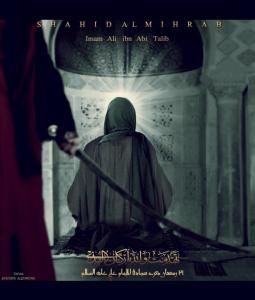
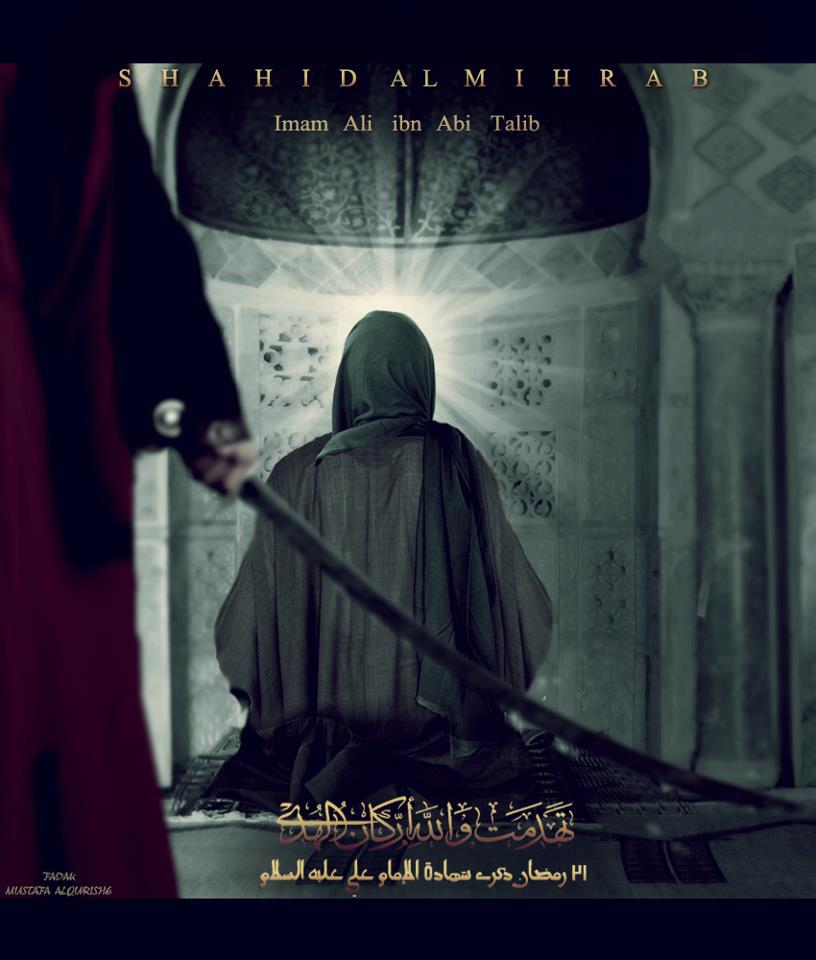
On the morning of the 19th of Ramadan of the year 40 A.H., Ali came into the Great Mosque of Kufa, and called Adhan (the call to prayer). He took his place in the alcove and moments later the worshippers began to arrive. They stood behind him in serried ranks, and the prayer began. Standing in the front row, with other worshippers, were Abdur Rahman bin Muljam and his confederates. They were watching Ali’s movements. In the folds of their cloaks, they were carrying swords burnished to a high sheen, and soaked in poison.
Just when Ali touched the ground with his forehead for sajda, Abdur Rahman bin Muljam stepped out of his row, and crept into the alcove. And just when Ali lifted his head from the ground, ibn Muljam struck the fatal blow at his forehead with such deadly force that it split open.
Blood squirted from Ali’s forehead in several jets, and he exclaimed:
“By the Lord of the Kaaba, I am successful!”
The members of the congregation realized what had happened, and as soon as they concluded the prayer, they surrounded him. His sons, Hasan and Husain, carried him to his house. A physician came, and tried to dress the ghastly wound but could not stop the bleeding. The blow of the sword was fatal anyway, but the poison from its blade was also spreading rapidly in his body. The Arab historians say that it was the second time that Ali was wounded in the forehead, the first time being when, in the battle of the Trench fought in 627, the sword of Amr bin Abd Wudd cut through his shield and helmet, and struck it. His forehead still bore the scar left by the sword of Amr.
Ali spent the time still left to him in prayer and devotions; in dictating his will; in giving instructions to his sons, ministers and generals regarding the conduct of the government; and in urging them all never to forget the old, the sick, the poor, the widows and the orphans at any time.
Ali declared that his elder son, Hasan, would succeed him as the head of the Kingdom of Heaven on Earth, and as the sovereign of all Muslims.
Though Ali was steadily weakening from the loss of blood and from the action of poison, all his faculties were sharp and clear right to the last moment. To all those people who came to see him, he said that they ought to be aware, at all times, of the presence of their Creator in their lives, to love Him, to serve Him, and to serve His Creation.
The poison had done its work, and on the morning of the 21st of Ramadan of 40 A.H., Ali ibn Abi Talib left this world to go into the presence of his Creator whom he had loved and served all his life. He was “God-intoxicated.” His greatest ambition in life was to wait upon his Creator, every moment of his existence, and he realized it, and this is the meaning of his exclamation in the alcove of the mosque when he felt the edge of the sword at his forehead: “By the Lord of the Kaaba, I am successful.”
Hasan and Husain washed the body of their father, draped it in a shroud, offered the funeral prayers for it, and then buried it silently at midnight at Najaf Ashraf, at some distance from Kufa. No markings were placed on the grave, and the grave-site was kept a secret, as desired by Ali himself.
Ali, Islam’s greatest saint, hero, statesman, philosopher and martyr, had left this world, and the world was not to find a man sublime like him to all eternity.
The Suffering of the Ahl ul Bayt and their Shia throughout History by Mateen J. Charbonneau, chapter 11 available at www.yasinpublications.com
Original source: The Restatement of the History of Islam and Muslims by Sayed Razwy

 mateenjc.com