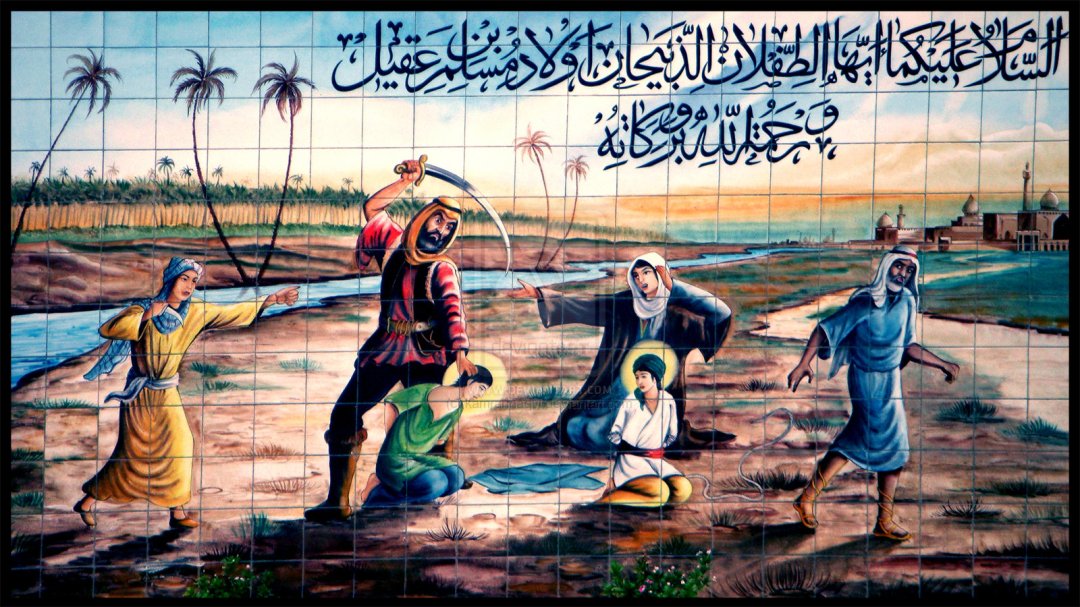
Muslim ibn ‘Aqil had taken two of his sons to Kufah with him. The older son was called
Muhammad and the younger Ibrahim. Both of them were under the age of ten years. When
Muslim ibn ‘Aqil realized how dangerous a threat Ibn Ziyad was, he called for Qadi Shurayh and
handed over his two sons to him. Qadi Shurayh kept the two boys in his house until the
martyrdom of Muslim ibn ‘Aqil.
After the death of Muslim ibn ‘Aqil, Ibn Ziyad issued a warning saying that anyone who was
aware of the whereabouts of the sons of Muslim ibn ‘Aqil and did not inform him would be put 171
to death. On hearing this, Qadi Shurayh went to the sons of Muslim ibn ‘Aqil. He showed them
affection and kindness as he shed tears. The boys asked him, “Why are you weeping?”
Shurayh replied, “Your father has been mercilessly killed.” The children cried in grief, “O father!
O exile!” After Shurayh had consoled them, he informed them of Ibn Ziyad’s threats against
them. Hearing this, the children stopped crying out of terror. Seeing this Shurayh said, “Do not
be frightened. You are the apples of my eye. I will not allow any harm to come to you. I have
arranged for you to be in the care of a trustworthy person who will see to it that you are taken
back to Medina.”
Shurayh called for his son Asad and gave him the following instructions, “News has come to me
that a caravan is preparing to depart for Medina. Take these children and hand them over to the
trustworthy person who will see to it that they reach Medina safely.” Shurayh kissed the two
boys and gave them each 50 dinars. Then he bade them farewell and handed them over to his son
Asad.
In the darkness of the night, Asad carried the two boys in his arms until he was a few kilometers
outside Kufah in order to meet with the caravan. However, the caravan had set off before they
arrived. The dark shapes of the rear of the caravan were barely visible in the distance. Asad bid
the two orphans of Muslim ibn ‘Aqil farewell and told to run after the caravan until they caught
up with it. Under no circumstances were they to stop before they had reached it.
In the darkness of the night the two orphans started running through the desert towards the
caravan. However, tiredness overcame them and they paused for a while. It was at this moment
that an inhabitant from Kufah happened to be passing. He saw the two boys and recognized them
as being the orphans of Muslim ibn ‘Aqil. He seized them and brought them to Ibn Ziyad.
Ibn Ziyad summoned the jailor and handed the two orphans over to him. The jailor was a person
by the name of Mashkur and he was among the lovers of the Household of the Prophet. When
Mashkur learned of the identity of the two boys, he treated them with great kindness and
affection and brought them food and water. Finally in the middle of the night, Mashkur decided
to free the two boys. He gave them his ring and instructed them to go to Qadisiyyah where they
would find his brother. He told them to give the ring to his brother who would then assist them to
get to Medina. When news of Mashkur’s freeing of the boys was given to Ibn Ziyad, he ordered
him to be given fifty lashes. Mashkur died as the sentence was being carried out.
On the same night Ibrahim and Muhammad, the sons of Muslim ibn ‘Aqil, left Kufah and started
their journey towards Qadisiyyah. They walked all night. However, due to the darkness and the
fact that they did not know the way, they found themselves still on the outskirts of Kufah in the
morning. The frightened boys saw a palm-grove and went to it. There they hid themselves on top
of a date palm.
An Ethiopian maid came to the palm-grove to drink some water from a pond underneath the tree
in which the children were hiding. As she knelt down by the pond, she saw the reflection of the
two children in the water. The maid quickly looked up at the tree and saw the young boys
concealed in it. She treated them with kindness and gentleness and took them to her mistress, 172
who was the wife of Harith ibn ‘Urwah. As soon as this woman saw them, she put her arms
around them and asked them who they were. They replied, “We are from the family of the
Prophet and are the sons of Muslim ibn ‘Aqil.” When she learned of their true identities, she
showed them greater affection and embraced her maid in joy. However, she warned her to not to
inform her husband Harith about the boys because she knew of his evil disposition.
After the boys had eaten and gone to bed, Harith returned home in a state of rage. When Harith’s
wife asked him of the reason for his anger, he replied that that he had been in search of the two
sons of Muslim ibn ‘Aqil who had been freed by Mashkur the jailor. He said that it had been
announced in the palace of Ibn Ziyad that the one who captured the boys would be rewarded
handsomely. However, despite a lengthy search during which his horse had died of exhaustion
and in which he himself had become tired, he had been unable to find them. At this Harith’s wife
said, “May sorrow be your lot! Fear God and the day on which Muhammad the Messenger of
Allah will be your opponent. Do not harm those children.” Harith replied, “Silence! O woman! If
I were to find them, I should be rewarded by vast amounts of gold and silver from Ibn Ziyad. Get
up and prepare my supper.”
After eating his supper Harith went to his bed. Muhammad and Ibrahim were asleep in one of the
rooms. Suddenly Muhammad the elder brother of the two woke up from his sleep. He had had a
dream that had disturbed him. He said to Ibrahim, “Wake up! O brother! I have just had a dream
and I am afraid that that we will soon be killed. I saw the Prophet with Imam Ali, al-Hasan, al-
Husayn and Lady Fatimah sitting in Paradise with our father. The Prophet looked at us and wept.
Then he turned to our father and said, ‘O Muslim! How could you leave your sons among the
enemies?’ At this our father said that they would be united with us tomorrow.” Ibrahim replied, “I
have had the same dream.” The children embraced each other in the darkness of the night,
frightened and not knowing what was to become of them.
Harith was woken from his sleep by the sound of the children’s voices. Holding a candle he came
inside the room and saw the two frightened children sitting in a corner of the room clinging to
each other. He asked, “Who are you?” They answered, “We are your guests, the family of the
Prophet. We are the sons of Muslim ibn ‘Aqil.” Harith shouted angrily, “I have destroyed myself
and my horse in searching for you while you were sitting inside my own house?”
Harith began to slap the children viciously. Then he tied their hands and feet and pushed them
into a corner of the room. Harith’s wife came to him and kissed his hands and feet begging him
to not to harm the children as they were orphans and from the family of the Prophet and their
guests. However, the hard-hearted man was without any compassion and paid no heed to her
pleas. Thus the boys were left in that state until the morning.
In the morning Harith, with his sword in his hand and accompanied by his son and his servant,
took the two sons of Muslim ibn ‘Aqil to the banks of the Euphrates. Harith’s wife was crying
and pleading with him as she followed them. However, whenever she got near to them, Harith
would push her away with his sword. At the Euphrates Harith gave his sword to his servant and
ordered him to behead the two boys. The servant refused to carry out his orders and Harith killed
him. After this Harith handed the sword to his son and told him to behead the two children. At
this his son replied, “I seek refuge with Allah! Never will I commit such a crime and I will not 173
allow you to kill them.” Harith’s wife cried out, “What crime have these children committed?
Take them alive to the governor.” Harith answered, “I have no option but to kill them, I have no
guarantee that members of the Shi’ah will not rescue them from me while I make my way to the
governor.”
At this Harith took hold of his sword with an intention of killing his own son. His wife screamed
and begged for mercy but to no avail. Harith took his son’s life. Then he turned to the children
who were crying and shaking with fear at what they had witnessed. The children begged for
some time for them to offer their final prayers but Harith did not grant them their wish. Harith
grabbed hold of Muhammad but Ibrahim threw himself on Muhammad in an attempt to save
him. Muhammad did the same in order to save the life of his younger brother. Impatiently Harith
struck his sword at Muhammad beheading him. Ibrahim grabbed the head of his brother in his
lap. As he wept over his brother, Harith struck at Ibrahim neck beheading the orphan.
Harith threw the headless bodies of the orphans of Muslim ibn ‘Aqil in the river and placed their
heads on a stake and set off to the palace of Ibn Ziyad.
The heads of the orphans of Muslim ibn ‘Aqil were brought and placed in front of Ibn Ziyad. The
latter asked, “Whose heads are these?” Harith replied, “These are the heads of your enemies
whom I caught and beheaded in return for the reward that you promised.” Ibn Ziyad asked,
“Which of my enemies?” Harith answered, “The sons of Muslim ibn ‘Aqil.” Ibn Ziyad asked for
the heads to be washed and brought on a tray. Then he gazed at them and said to Harith, “May
sorrow be your reward! What wrong did these children do to you?”
Ibn Ziyad called for his personal jester Muqatil who was a devoted lover of the Holy Family and
to deny the murderer death at the hands of soldiers said, “This accursed man has killed these
children without my permission. Take him to the banks of the Euphrates where he murdered the
children and execute him as you will.” Muqatil grabbed Harith by the shoulders and marched
him through the streets of Kufah bare-footed and bare-headed as he showed the heads of the
orphans to the onlookers shouting, “O people! This is the murderer of the two orphans of Muslim
ibn ‘Aqil.” The people wept at the sight of the orphan’s heads and cursed Harith. As Muqatil
proceeded to the river, the people gathered with him to witness Harith’s execution. When they
arrived at the place where the children were killed, they found the dead bodies of Harith’s son
and his slave and his bruised wife crying over her son. The people were extremely disturbed at
the scene.
Harith asked Muqatil to release him for the sum of ten thousand dinars.
To this Muqatil replied, “By Allah! If all the wealth of the entire world were yours and you
offered it to me, I would not accept. I desire to attain the Paradise of Allah by executing you.
His head was brought to Ibn Ziyad, it was placed on a lance and children threw stones and
arrows at it and said, “This is the murderer of the progeny of the Prophet”
The Suffering of the Ahl ul Bayt and their Shia throughout History by Mateen J. Charbonneau pages 170-173
The Tragedy of the Two Young Sons of Muslim Ibn Aqil, Nafasul Mahmoom, Shaikh Sadooq has related this in his Amali


 mateenjc.com