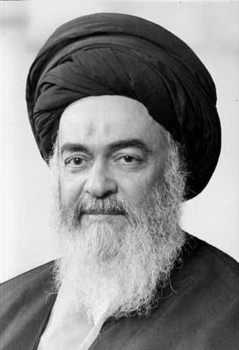
Four Vital instructions from the late Sayed Muhammad Shirazi

In the name of God, the Beneficent, the Merciful.

There are four issues that you must not forget: One is about God. We must always remember God. “And He is with you wherever you are.” (57:4) Wherever you are, whether in the Hussainia, at the store, at home, or in the market, God is with you. Your eyes, your ears, and even your thoughts, whether they be good thoughts or bad thoughts, will all be held accountable.

One of the scholars of Karbala was seen in a dream, two years after his death. Keep this story in mind. They asked him: “How is the Hereafter?” He said: “I was successful for sure, but there was only one thing that God held me accountable for. One day a load of firewood was passing by, and I took a small piece of wood and broke it to pick my teeth with. God told me: “Why did you take this from the people’s firewood?” In the afterlife, we will be held accountable to this extent. Every word is judged, everything you hear is judged, and every handshake is judged.

First thing is God. Every morning when you wake up, you must remind yourself to remember God. Always remember this thing. One who is with God, God is with him.

One who is with God rises, and one who isn’t with God falls. Remember God at work, in school, at the podium, in your prayers, and at home.

The second issue is death. The Prophet once said: “Which person is most clever?” Is it the one who has money? No. One who has knowledge? No. One who has an audience of 100,000 people? No. One who has a position? No. None of these people are clever.

He said: “The cleverest person is the one who remembers death.” To remember death.

The day will come when we will all die, and we will all become beneath the earth. Neither will I exist nor will you, and nobody will even remember our names.

One must consider this day and remember this day before every action. They asked the Prophet: “How many times should we remember death every day?” He said: “At least 30 times.” This means when you wake up in the morning, remember that you will die, when you pray remember that you will die, and when you go to the market remember that you will die. If one becomes like this, one will always be a truthful person. On one hand remember God, and on the other remember death. One who is with God always remembers death, and God will give him all his needs.

There is a small story which is often told by the speakers. There once was a ship that was drowning at sea, and everyone in it was crying, weeping and praying. There was a black slave who sat quietly without saying anything. They told him to say something but he wouldn’t, so they insisted. Always remember this story. He raised his head and said: “Oh God! I’ve fulfilled my part so fulfill yours.” Suddenly the sea calmed down. They gathered around him and asked him: “Who are you?” He said: “I’m a black slave, but I’ve made a deal with God that if I listen to his commands, He will also listen to my requests. Until now I’ve listened to God’s commands, so I told God to listen to my wishes, and He did so.

If one follows God, God will listen to his demands. He has said in the holy Qur’an: “Be faithful to your covenant with Me, I will fulfill My covenant with you,” (2:40)

Always be with God, and always remember death. These are two issues.

The third issue is to struggle to spread Islamic teachings everywhere possible. This is your duty. This is the third issue.

The fourth issue is to help the poor. Don’t say I don’t have money, and my salary is only 1,000 tomans. Split the 1,000 tomans in half and give one half to the poor. If you give half of your salary it would be called empathy, and if you give 990 from 1,000 it would be called altruism. God taught us how to be good; we are the followers of this path. God says: “And (the believers) prefer them (the poor) before themselves…” ­ (50:9)

This means if I have a piece of bread and this man and I were both hungry, I’d give all of it to this man. What did Lady Fatima, Imam Ali, Imam Hassan, and Imam Hussein do?

They gave their own bread to the people. They didn’t say: “Let’s only give one-fifth or half of what we have.”

We must apply the fourth issue and rescue the poor people of society, like the homeless, the unmarried youths who can’t afford to get married, the sick people and those who don’t have a refuge.

Don’t assume that only the scholars and the speakers should help, and don’t assume that only the wealthy and the governments should help. What did the Prophet say? He said: “You are all shepherds and responsible for your herd.” Everyone must contribute according to his ability. Decrease from your share and add to the share of others.

In one of the wars called Tabuk, every two Muslims used to share one date, and everyone ate one half of a date in the state of war. We must personally help the people. One must help everyone. We must not forget God, death, spreading Islamic teachings, and helping people. These are four issues that we must not forget.

And may God send his prayers upon Muhammad and his pure family.


Sayed Muhammad Shirazi

Copy-of-19


Life as a Shia Muslim inside the U.S. Penitentiary

Thursday, May 22, 14

 Let me start by saying that I do not retell these penitentiary stories often. That was a very rough stage in my life that, through the grace of Allah, I was able to overcome. For those of you who have not heard my story on how I became incarcerated and what led me to accept Shia Islam, I would ask you to please watch the documentary about my life titled Journey of the Spirit filmed by Anwar al-Hussain TV in 2011. I was asked to tell about my experience by someone who is doing a documentary about life as a Shia Muslim inside U.S. Prisons. They asked me to elaborate on the situation of the Muslims in Prison, sectarian tensions, sectarian violence, and obstacles that Shia face in prison, etc. This is the purpose of me writing this article. I do not wish to promote hatred or further sectarian strife, but only to recap my interactions with people from the Sunni, Salafi and Wahhabi sects. I will tell a few of the instances that come to my mind and try to paint a picture of what the situation is. I was incarcerated for 9 years in South Carolina prisons. I can only speak for what happens there, although I have been receiving letters to an organization I work with that serves prisoners eager to learn more about Islam, 2nd Chance Books, from prisoners around the country saying they are suffering similar trials and tribulations.

In the majority of the prisons there are usually large Muslim congregations. The majority of these Muslims are from either the Sunni, Wahhabi, or Salafi sects. However, they all call themselves Sunni Muslims, but they say they follow the “Salaf-us-Saliheen” (righteous predecessors) and they study from the books of Muhammad ibn Abdul Wahhab, the founder of the Wahhabi sect, and Ibn Tamiyyah who promoted hatred and violence towards those who did not subscribe to his views. Throughout this article I will refer to them as Sunnis, due to the fact this is the term that they used for themselves. As for Shia Muslims there are usually a handful of people who converted to Shia Islam in each prison. They convert after reading and studying books about Ahl-ul-Bayt (AS) that made their way into the prison system through different organizations in the USA and Iran. The reason that there are so many Sunnis, Wahhabis, and Salafis in prison is because the majority of the Muslim Chaplains subscribe to one of those schools of thought. Also, they receive numerous free books from Saudi Arabia that they disburse throughout the prisons for free. They try to control the masses by telling them only what they want them to hear and pushing their own ideology and agenda. They send in books by Muhammad ibn Abdul Wahhab, Ibn Tamiyya and even go as far as disbursing books like the one titled “Demolishing the Creed of the Shia” and other books that call Shia Muslims disbelievers, insult our Imams (as) and provoke aggression.

The Shia Muslims are the minority and are oppressed by others for being so. The main point they criticize the Shia for is that the Shias’ adhan (call to prayers) and salat (prayer) are different than theirs. They also do not agree with the Shias following the Imams of Ahl-ul-Bayt (AS), the belief in infallibility and do not agree with the Shia for criticizing and scrutinizing some of the sahaba (companions of the Prophet). From my own experience the only way that they would leave you alone was if you could prove your beliefs and actions through books. This is why it was vital for every Shia Muslim to be well equipped with the knowledge to defend his faith. It is reported that the Prophet (SAWA) said, “One learnt Muslim is harder on the Shaytan than 1,000 ignorant worshippers.” If you could show them the source for your point of view, then they would leave you alone and let you practice, despite how upset and frustrated it made them. They would then ostracize you and tell all the rest of the community to avoid you, not to talk to you and most importantly not to accept words, advice, or literature from you. Even before the new Muslim knew how to pray they would be told whom to stay away from.

When I became a Muslim in 1999 the majority of the Muslims were Shia and the administration tried to break up our community. They sent many Sunni ulema (scholars) from the mosques around America into our prison to try to “correct our deviant beliefs.” Every time they tried to come and debate us we would defeat them through our knowledge and good akhlaq (ethics and behavior). Eventually they thought the solution would be to separate all of the most learned in the community. They thought if they could separate the head from the body that it would destroy the community. So, they relocated us to different prisons throughout the state. Little did they know, instead of killing the Shia belief in the prisons they actually spread it. At all of the prisons we went to we became teachers and educated whole communities of Muslims and taught the teachings of the Ahl-ul-Bayt (AS) to everyone we came in contact with.

I would like to discuss a few instances of oppression from my personal experiences inside the prison system as a Shia Muslim. After they started breaking up our community and they shipped our community leader to a different prison, the Sunni inmates took over and put one of their people in position as head of the community. The first Jum’ah (Friday) sermon he delivered was one and a half hours on describing the sins, faults and errors of the Prophet Muhammad (SAWA). (May Allah save us from their lies!) I couldn’t take it anymore. After all, my favorite sahaba (companion) was Abu Zar al-Ghifarri who stood up during the prophet’s time to publicly declare his belief in Allah despite the harsh oppression the Muslims were under. The idolaters beat him and he got up and did it again and this happened three times before the uncle of the prophet Abbas intervened. Also he is the one who defended the rightful position of Imam Ali (AS) as the successor to the Prophet (SAWA), after the three unjust Caliphs took his position by force. Abu Zar used to stand in front of the palace of Uthman and Muawiya and would publicly recite those verses from the Quran that cursed the oppressors. This eventually led to his exile and also his martyrdom. So back to the situation at hand, I stood up and started saying to the whole congregation that this man who spent over an hour slandering our beloved prophet (SAWA) was wrong and I refuted all his claims from Quran and ahadith. They got really upset with me and got prison security to make us all leave.

A few days later at the afternoon salat, the Chaplain had got word from the Salafi inmate that was running the prison community that we Shia were causing trouble. The Chaplain invited a Hafez of Quran (a person who has memorized the whole Quran) from Somalia. The Hafez said that he would like to debate us Shia, but would only debate one who knew the entire 12 Imams by name. Unfortunately not many of the Shia knew all of the names sequentially, but I at 18 years old stood up, named all of the Imams (AS) and gladly accepted the challenge. He said that Shia was a word that was not mentioned in the Quran at all, but rather a term and religion that came many years after the Prophet (SAWA). I asked the man if he was indeed a Hafez of Quran, which he replied in the affirmative. I then proceeded to tell him about the ayat in Quran where Allah says “And most surely, Abraham was among the Shia of him (Noah)” (Quran 37:83) and “And he (Moses) went into the city at a time when people (of the city) were not watching, so he found therein two men fighting, one being of his shia and the other being his enemy, and the one who was of his shia cried out to him for help against the one who was of his enemy” (Quran 28:15). I asked him to confirm if these were both in the Quran or not. He had to answer yes and admit that Allah called the followers of His prophets Shia. The Chaplain started making commotion and said the time for Salat had come in and started to call the adhan to end the humiliation of the scholar he brought to debate us.

The next day following this debate I was returning to congregational salat when my close friend told me that some non-Shias in his dorm had planned to stab me and another brother, who was my teacher, while we were praying our salat-uz-zuhr. He had heard from someone else that was not in agreement with the plot. So when we went to pray, my close friend, who is also Shia, stood back and didn’t pray congregation. He was concealing a knife as well and was going to stop anyone who tried to hurt us. They tried to get him to pray with us, but he told them that he had already prayed in the dorm and thus the plan was foiled. The day after that, they shipped me to a different prison and upon arriving to that prison the community made me their minister of education where I taught Islamic studies classes for the next year. I am glad to say that I am still in touch with this brother who was willing to risk his life for me. He is currently serving a life sentence and since my release I have been equipping him with all the necessary materials he needs to help him and the Shia community.

Another instance was in my last year of incarceration I happened to run into a guy that was my roommate 8 years prior. I taught him about Islam and actually taught him how to perform his prayer. Like I said earlier, I got shipped away shortly after that incident and the guy remained there and ended up learning all of his religion from the non-Shias that were now running that community. So now this guy was brainwashed by them and when we started to pray he got furious at me and said I was doing it all wrong. Of course I proved all of the Shia practices for him from the books that I had in my possession. Him and his goons said that we were not allowed to pray with them in the shared prayer room that we had in the dorm, unless we prayed the exact way they did with our arms folded, saying ameen after Surah Fatiha, etc. This was my last year and I was very close to going home so I didn’t want to preoccupy myself with this sectarian drama. I told the other Shia brothers in the dorm that we will just pray at a different time than they did, for example, slightly later because our Maghrib comes in at a later time. So we continued to pray in the prayer room at a different time than they did. This was not enough for them, so they said if we continued to use the room there would be consequences. I am not one to be pushed around and we had every right to use the room. I went into the room at prayer time and called the adhan loudly and said “Ashhadu anna Aliyan waliyullah” proudly as loud as my voice would allow. When I finished calling the adhan I turned around and the guy was in the prayer room waiting on me to finish. He was telling me to leave and I refused so he pulled a knife on me, but thank God my friend and fellow Shia brother came rushing in the room and said that if anyone wanted to hurt me he would have to go through him first and had a big knife in his hand. The guy got scared because he saw my friend was serious and he left the room. He went and rounded up the others and came back to try and team up on us. By this time it escalated into more than just Muslims. The people from our hometowns got involved and it was going to turn into a riot. Nobody wanted that to happen so when it came down to it both sides that rose up to fight called him and me into a room and wanted to see the real issue. I explained what happened and then the people from his hometown did not want to fight us over some religious dispute and convinced him to leave it alone, to which he agreed.

I was tired of these people trying to convert me to their violent version of the religion by force and I went and got the words tattooed on my arms Shia on one arm and Ahl-ul-Bayt on the other to show them that I would always be a Shia. They finally left me alone and considered me a lost cause for converting. About a month later I was sent to a pre-release center to prepare for my entrance back into society.

294318_3988545870987_904234215_n

All of this violence and harsh behavior came from ignorance and lack of the true teachings of Islam taught to us by our beloved Prophet (SAWA) and his Family (AS). Saudi Arabia has used their wealth to print thousands of books and distribute them freely to prisons across the world. We as Shia need to step up to the plate and get these brothers the correct information about the Ahl-ul-Bayt (AS). It is our duty to help them and show them the correct way, the way of tolerance and peace. They can learn so much from the ethics and morality of the family of the Prophet that they could change their lives and become outstanding citizens.

This is why some like-minded brothers and I started an organization titled 2nd Chance Books, which Ahl ul Bayt TV filmed a documentary about entitled Faith Behind Bars. This program will provide the proper tools for change: Free Islamic books on belief, ethics, morality and family structure in Islam. They can use these books as a tool for self-development and to reform themselves and also their friends, loved ones, and communities upon their release. Some of the many benefits of this program are the changing of prisoners’ bad habits into good ones, achieving social reform by teaching the morals and ethics of the Holy Prophet and his Holy Household (AS), molding leaders, producing better citizens who will be active in helping their communities upon their release, promoting awareness of the true teachings of Islam as taught by Prophet Muhammad (SAWA) and his Holy Household (AS) and removing misinformation and misconceptions about Islam and Muslims from people’s minds. This program is funded by donations to our publishing company, Yasin Publications. A donation of $25 is used to sponsor sending a prisoner a package of up to six books.

We ask everyone if they are able to please visit http://www.2ndchancebooks.org to contribute and give the gift of knowledge to a person that could change their life and possibly the lives of everyone they interact with.

I hope and pray that this information was beneficial to the reader and that you gained a better perception about the struggles our brothers in prison go through on a day-to-day basis. May Allah grant them knowledge, guidance and protection from the oppressors. Please keep the prisoners, the forgotten believers of our community, in your prayers.

Mateen J. Charbonneau


If you want to see a man of determination then look to Abu Fadhl Abbas ع. When he went to get the water for Imam Hussain ع and the children, who did not drink for 3 days, he was faced with many difficulties. He had his right hand cut, so he carried the water with his left hand, he had his left hand cut, then he carried the water bag with his teeth until he was struck in the eye with an arrow that knocked him down from his horse. He never gave up, but instead gave everything he had in the way of serving his master Imam Hussain ع.

As salamu alayka yaa qamar bani hashim!

922123_10151556310444907_1252169237_o