Bilal of Africa’s protest and banishment to Syria

Bilal of Africa was the first muezzin of prayer (person who calls to prayer). When Madina developed all the characteristics of a state, it also acquired a treasury, and the Prophet appointed Bilal its officer in charge. He was in charge of the bayt ul mal (Treasury) of the state of Madina. This made him the first treasurer of Islam. He made allocations of all funds. He was also responsible for distributing funds to the widows, orphans, the wayfayers and other poor people who had no means of supporting themselves.[1]
From the day the Holy Prophet and other Muslims migrated to Madina Bilal used to call the the people to the mosque to gather them there i.e. at the time of prayers, mobilization of the army, or when there was a problem to be solved he used to say adhan and immediately the people poured into the mosque and formed a gathering.
All were familiar with the voice of Bilal and they always waited to hear his invigorating call which invited them to Allah and to good things.
However, when after the Holy Prophet, Abu Bakr attained to caliphate he decided to go to the mosque in that capacity and to stand in the Prophet’s niche so that by this means he might strengthen the pillars of his government and contact the people directly. The first step for the formation of a gathering and the people coming to the mosque while the Prophet was alive was the saying of the adhan by Bilal inviting them to the mosque. However, Bilal did not say adhan after the Holy Prophet’s demise and was the most sensitive, the most natural and at the same time the most dangerous tactics which Bilal employed against the caliphate. From that point onwards Bilal did not participate in any official gatherings of theirs. The absence of Bilal, who held a delicate post, from the stage and the society, could make the people think about the problem of the day.
The supporters of the caliph thought that if Bilal said the adhan the hue and cry of the opponents of the caliph would die down and the people would come to the mosque as they were accustomed to do on hearing the voice of Bilal. The saying of adhan by Bilal could draw a curtain on the intrigue of the administration of the caliphate and deceive the simple minded and common people.
With these thoughts in mind they located Bilal after a good deal of search and asked him to say the adhan for the prayers.
Bilal had been trained in the lap of Islam for twenty three years and had been directly concerned with the various events which formed the history of the new nation. He had recognized and accepted Islam with sincerity and had heard what the Holy Prophet had said with regard to the leader and leadership. Especially he was aware of the unambiguous remarks of the Holy Prophet about the caliphate of Imam Ali and knew that the ruling administration had come to power against the orders of Allah and the Holy Prophet. According to his belief only the commander of the faithful Imam Ali was entitled attain the caliphate. In the circumstances it is evident as to what reply he was going to give to those who approached him.
The messengers of the caliph insisted very much but Bilal repeated the same reply every time and did not pay any heed to their words.
By not saying the adhan Bilal wished to oblige the people to think about the matter and to remind themselves gradually of the time of the Holy Prophet and the recommendations made by him with regard to Imam Ali and to his Imamate. It was this reason that when people asked him as to why he did not say adhan he said in reply “After the Holy Prophet of Islam I shall not say the adhan for another person.” On the other hand non participation of the commander of the faithful, Salman, Abu Zar, Zubayr, Bilal, Miqdad, Sohayb, etc. in the gatherings which were usually formed in the mosque strengthened Bilal’s stand and became the cause of the people doubting the rightfulness and legality of the ruling body and even objecting to it.
The administration of the caliphate was scared and worried because of the stand taken by Bilal and tried to make him and other opponents surrender.
It was in this state of fear that the caliph sent some people formally to Bilal to make that “obstinate and inflexible black man” surrender to the caliphate at any costs by means of promises, threats, or allurement of money and position.
However, Bilal was not prepared to ignore the truth and “to do as the Romans do.” He saw Islam personified in Imam Ali and believed that even if the recommendation of the Holy Prophet had not been there, no one except Imam Ali was fit for the caliphate. He was convinced that true Islam was the same which was put forward by Imam Ali and his friends though few in number. He, who had borne hardships and suffered torture for the same Islam, could not now see it as a plaything of material desires and of the administration of the caliphate. He, therefore, gave a clear cut reply to the representatives of the caliph in these words.
“I shall not say the adhan for anyone except the person whom the Holy Prophet selected as his successor.”
At last Umar, who was a close friend of the caliph Abu Bakr and was considered to be the most important factor for his selection as caliph and great supporter of his continuance in that office decided to discuss the matter with Bilal personally.
When Umar saw Bilal he was thinking: “Now I shall make him surrender and shall take him out of the fold of the opponents of the caliph.”
After salutation and exchange of compliments Umar said: “O’ Bilal! Why have you left us alone these days? I was very keen that you should be with us so that we could entrust you with some tasks. Why don’t you come to the mosque? We expect you to say adhan and call the people to the mosque to offer prayers with the caliph of the Holy Prophet. I understand that you have said that you will no longer say adhan. Why so? Do you remember that this very Abu Bakr delivered you from the slavery of and persecution by your cruel master? Is it proper that you should abandon him now and should not say adhan for him?”
Bilal began recollecting the past events of history like persecution and the period of his banishment and homelessness, his migration to Madina, military engagements with the infidels and the polytheists, conquest of Makkah and the passing away of the Holy Prophet. He said to Umar: “How happy were the days when the Holy Prophet was among us and invited the people to Allah and justice. And how hard, dark and calamitous these days are! With what conditions are we confronted?”
Bilal turned the conversation to the matter under discussion and while tears were flowing down his cheeks he continued to say: “Let us see whether Abu Bakr purchased me for the sake of Allah and set me free for the sake of Allah, or he had some other motive. If he did all of this for the sake of Allah he does not enjoy any right on me and if he did not act for the sake of Allah, I am still his slave and under his control, but I am free in the matter of faith. And as I have already said I am not going to say adhan for any other person after the Holy Prophet. Furthermore I am going to swear allegiance only to that person whose allegiance is my responsibility. I accept only that person as Caliph who has been nominated by the Holy Prophet as his successor. And then I say to you if Abu Bakr had not purchased me and set me free on that day and I would have died in that condition, because I was then certainly a true believer and would have gone to paradise. But in the present circumstances when you want me to participate in this matter I do not know whether I am destined to go to paradise or hell and whether or not I can preserve my faith.”
Umar was very much annoyed on hearing these words and cast on Bilal a harsh angry look full of scorn. After a few moments he got up and went away much agitated.
All the plans of the administration of the caliphate for making Bilal surrender were frustrated and it could not cause the slightest damage to his firm determination. He persevered fearlessly, did not listen to the promises made with him, remained undaunted in the face of threats, and did not surrender. In view of the stand taken by Bilal and the sensitiveness which had been created in the society owing to his refusing to take the oath of allegiance to Abu Bakr the administration of the caliphate drew its last plan to punish him. As it was feared that some people might join him and trouble might increase, one of those present suggested that it would be better if Bilal was exiled from Madina to a place distant from the capital so that by this means the hue and cry might come to an end and the people might forget him.
However the advisors of the caliph said: “If we exile him openly we shall be blamed more. It is possible that Imam Ali may object to it. In that event our action will produce a result contrary to that desired by us. It will, therefore, be better if he is subjected to threats and torture so that he may be compelled to leave Madina of his own free will.”
This scheme was approved by the majority vote and accordingly Bilal was tortured during day and night and subjected to threats of death. At last he received a message on these lines: “Either you should swear allegiance to Abu Bakr and say adhan or quit Madina.”
Some historians have written thus: “Umar said to Bilal: Now that you do not say adhan you should not remain in Madina so that you may not become the cause of corruption of others.” And he subjected Bilal to pressure.
Thus the spokesman of the movement of Islam was placed in a strange predicament. On the one hand it was difficult for him to forsake the city of the Prophet and on the other hand it had also become impossible for him to stay there. He pondered as to whether he should stay on in Madina or resist the pressure.
After all how could he abandon Madina the tomb of the Holy Prophet his master, as it was the city of his friend with many remembrances? However, he was obliged to prefer going away from there so that possibly he might persuade the people more to think about the current and unsatisfactory affairs and also they might resort to objection, criticism, and occasionally disobedience, and possibly the usurped right might return to its owner. This had to be done because there was no other remedy. If he had stayed on in Madina it would have been necessary for him to agree with the rulers and he would have to explain the existing situation and his own stand. If he had stayed on he would have to confirm the actions of the government and this was impossible for Bilal, because in his opinion these actions were unjust. He decided to go to Syria and got ready for the banishment come what might. Before deciding to leave Madina Bilal had consulted the family of the Holy Prophet. When he got ready to depart he first of all went to see and say farewell to Imam Ali.
This meeting took place in a very disturbing atmosphere and the Holy Imam was much moved. Tears were rolling on the cheeks of Bilal like pearls and perhaps he was saying ‘If I had the option I would not at all have gone away from you and the tomb of the Holy Prophet. I hope that I shall return.’ Then he visited the tomb of the Holy Prophet in a state of extreme sadness and kept weeping for a long time. He said: “O’ honorable Prophet of Islam! You yourself are aware of how sad days we are passing and what a strong blow has been struck on the body of your religion. O’ Prophet of Allah! I have in fact been compelled as a consequence of the ever increasing pressure of the administration of the caliphate to go away from your city to Syria.”
At the time of dawn of that night Bilal departed from Madina and proceeded to Syria.
At last after surmounting various difficulties faced by him on the way between Madina and Damascus, Bilal completed the journey. When he came near Damascus he stopped for a moment and stared at the city with surprise and said to himself: “What a dull and sad city it is! It appears that death has cast its shadow everywhere. O’ Lord! How can I live here? I have been thinking that the journey has come to an end and I can take rest for awhile, but now I have become more tired and sad. O’Lord! What should I do?”
“I ought to put up with their condition and remain patient while I am away from my master Imam Ali and his faithful companions. When I have borne all these inconveniences how can I live here as I did in the past?”
Bilal proceeded to the gate of the city with a very heavy heart and located a place for himself after a good deal of wandering and searching.
Bilal was pleased and satisfied because he had been able to withstand the oppression and strength of the powerful persons and to speak the truth. He thanked Allah and prided himself on his own existence on seeing that his very being was dangerous for the rulers and they feared even his silence.
Bilal resided in Damascus for some time. Though he himself was in Damascus, his soul was in Madina. He was continuously thinking about some solution of the problem. At last he lost patience and decided to return to Madina so that he might see the family of the Prophet and his honorable Imam once again. He also thought the political condition of the government would not consider his return to be expedient, and it was possible that they might restrain him. However, as he had taken a decision he said to himself: “I shall perform this journey even though it may cost me my life.”
Bilal left Damascus with great courage and enthusiasm and special attatchment to the Prophet’s family. The path which seemed to be long at the time of his starting the journey was covered soon. He reached near Madina and saw the quiet spectacle of the city. He saw the walls of the Holy Prophet’s mosque from a distance and recollected the sweet memories of the past. He sighed and tears began to flow from his eyes.
After his arrival in the city Bilal went immediately to the tomb of the Holy Prophet. The spies also saw Bilal and thought of arresting him. However, they did not consider it expedient to do so, but went to the authorities and reported the arrival of Bilal to them. The authorities were scared and worried on hearing this news. On the other hand this news reached Lady Fatema Zahra the beloved daughter of the Holy Prophet and in the meantime Bilal came to know that she was not in good health. The news distressed him and he began humming by the side of the tomb of the Holy Prophet.
“O’ Prophet of Allah! After you the world has become dark and Imamate has been converted into caliphate and it has been usurped by people who are not fit for this position. O’ Prophet of Allah! I have come to know that your daughter is not in good health. O’ Prophet of Allah! Your successor Ali is staying at home. By means of his silence he is preserving the exaltation of Islam and the unity of the Muslims. O’ Prophet of Allah! I have just returned from my journey to Syria. I had been exiled there……….”
Then due to acute disturbance of mind Bilal fell down on the ground and became unconscious.
After the demise of the Holy Prophet his only daughter Fatimah who dearly felt the separation of her beloved father, gradually became ill. And when she heard that Bilal had returned to Madina she expressed the desire that he should say adhan once again.
Time for noon prayers approached. The muadhin of the Holy Prophet went on the roof of the mosque and began to say adhan with his loud voice as he had been doing in the recent past. He said Allahu Akbar!”
On hearing the voice of Bilal, the first muadhin of the Holy Prophet the people of Madina came out of their houses and proceeded to the mosque. All of them wondered as to how Bilal was saying adhan again after the death of the Holy Prophet. A few moments later a larger number of people gathered in the mosque and Bilal continued to say adhan.
When Bilal pronounced Takbir loudly and Lady Fatimah heard it in her house she was reminded of the glorious and sweet days of her father’s time. She sighed and began to weep. Her children also joined her in weeping. When Bilal said “Ashhadu an laa ilaha illAllah” (I bear witness that there is no God but Allah) Lady Fatimah wept more bitterly. However, when the adhan reached the delicate stage she lost her sense owing to intense grief. Bilal was, therefore, advised to stop saying adhan at once, because the life of Lady Fatimah Zahra was in danger.
The people who gathered near the mosque, in the streets, on the roads and in whose eyes a particular enthusiasm and fervor was rolling suddenly came to themselves when Bilal’s adhan was cut off and wondered as to why this had happened.
Of course, Bilal said his last adhan with his entire self and with his faith in the Holy Prophet and love for his school.
Bilal, who was no longer keen to live owing to the pressure of hardships, got ready to play an enlightening and informative role among the people with his political activities. He mobilized the people against the people of authorities in government by means of discussions and fiery speeches in such a way that the people began to raise objections and shouted harsh slogans of protest against the government and it was feared that they might cause disturbances. The agents of government, therefore, poured into the mosques arrested Bilal and exiled him to Syria once again.
After his second exile Bilal was not permitted even to take permission from the Holy Prophet’s sacred tomb because the officials kept a watch over him everywhere and he himself realized the position very well. Hence, he turned his face to the tomb of the Holy Prophet and opened out his heart for quite some time after offering him salutations.
Bilal arrived in Damascus and was much grieved on account of the conditions which had been created for him. He prayed for Islam and the Muslims day and night and felt very sad when he saw in danger the pains taken by the Holy Prophet for many years.
Indeed Bilal was living in Damascus under extreme pressure by the government. It was very rare that anyone might be able to see him and at all times he lived alone. The matters had come to such a pass that he now greatly suffered on account of lonliness.
Bilal was born like this, lived like this and eventually ascended the alter of love. It was an ascension which took him to the highest peak of glory and martyrdom. Now he is in the great world with a world of greatness. All his friends were shedding tears on his martyrdom. It was Bilal the black slave who made history and rolled up the old aristocratic order of the age of ignorance and began to shine as an eternal face which will serve as an example in the annals of history of mankind. He has really made himself immortal. He has become a paragon of piety and purity.
The people were endeavouring much to glorify and attend his funeral. All those who were participating in the ceremonies of his burial were weeping bitterly. Damascus was one of the important bases of Umayyad imperialism and the theatre of appearance of the usurped caliphate of the unlawful heirs of the Islamic revolution. Still, in spite of the savage and tyrannical rule of Bani Umayyah, a large number of people attended his funeral. In other cities of the Islamic territories and especially in Madina the people were very much grieved and saddened. They mourned Bilal’s death for a long period. Bilal was one of those few people who defended the truth till the last moment of their lives. He preached true Islam. Neither the tortures of different kinds weakened his firm determination, nor was he allured, nor terrified by threats, nor did he swear allegiance to an undeserving person, nor did he sacrifice Islam and reality for the sake of expediency, worldliness, name and wealth.
After leading a life of freedom and self-sacrifice in the path of Islam, Bilal passed away in such circumstances that he possessed no material thing. Noble minded Muslims buried his dead body in the graveyard named Saghir situated in Damascus and mourned his death for some days. His grave is a place of pilgrimage of the Muslims and freedom loving people of the world from that time until today. It is the grave from which lessons of freedom, reality, sincerity, self-sacrifice, and steadfastness are learnt and which teaches us as to how a person should live and how he should die.
All of the Muslim historians, to whichever sect they belong, while mentioning the close and faithful companions of the great leader of Islam have named Bilal as one of them and have placed him in the the category of those who were near him. Thus it is observed that in consequence of Islam and enforcement of its commands and valuable teachings Bilal, who was not more than a slave before the dawn of Islam, secured such a high status that he was reckoned to be one of those people who were the most sincere, the most devoted, and the most proximate companions of the Holy Prophet.
So long as Bilal was alive he endeavored for the advancement of Islam and was sincerely devoted to the family of the Holy Prophet till the last moment of his life.[2]
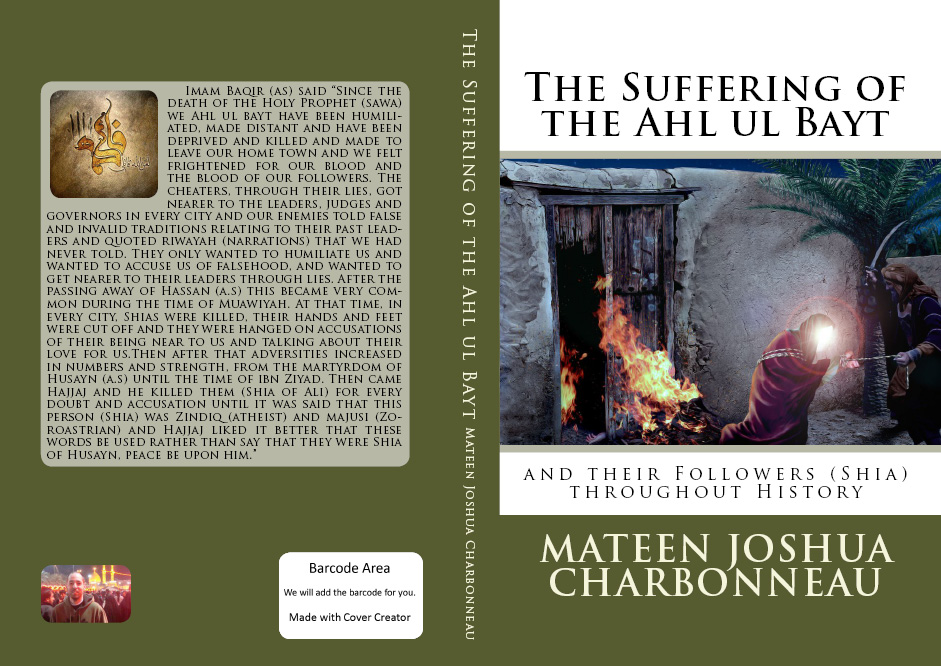
Chapter 3 from The Suffering of the Ahl ul Bayt and their Followers (Shia) throughout History by Mateen J. Charbonneau
[1] A Restatement of the History of Islam and Muslims page 553
[2] Bilal of Africa by Husayn Malika Ashtiyani pages 100-111
The Martyrdom of Qasim ibn Hassan (as)

When Qasim saw that Aun and Muhammad had been granted permission to march out on the entreaties of their mother, he rushed to his mother’s tent. Almost sobbing with disappointment, he told Umme Farwa that Aun and Muhammad had secured the Imam’s permission on the intercession of their mother but he had nobody to plead on his behalf with his uncle. In utter despondency he said; “If I am not destined to be a martyr on this day, life has no charm left for me. Am I destined to be a captive and led through the streets to a prison cell?”
Upon seeing Qasim so bitter and dejected Umme Farwa burst into tears of grief. Controlling herself she began to think what to do to get Husain’s permission for him. Her first reaction was to go over to the Imam and to implore him as his brother’s widow and seek permission for Qasim. However, in a flash she remembered her husband’s words to her shortly before his death. He had told her that for Qasim a time may come when he would find himself in the trough of despair and despondency and feel dejected and depressed beyond description. He had told her that, when this happened, she should deliver to him an envelope wherein he had kept a letter specially for this occasion. This she had carefully preserved and kept with her as her most cherished thing in a box. Fortunately for her, she had brought the box with her. She hastened to fetch the letter and handing over the envelope to Qasim she said: “Qasim, your present plight brought back to me your father’s words that a day like this would come for you and when this happened, I should deliver the letter to you.” With rekindled hopes and expectation Qasim took the envelope from his mother’s hand and opened it. In it he found two letters one addressed to himself and the other addressed to Hussain.
He anxiously opened the letter meant for him and read it aloud for his mother’s benefit. Hasan had written in it: “My child, when this letter reaches you, I will be no more. When you read it, you will find yourself torn with a conflict between your desire to do your duty and fulfill your obligations and demonstrate your love and esteem for your uncle, and his love and affection for you compelling him to hold you back. My Qasim, I have provided for this event by arming you with a letter for my dearest brother Hussain. You may deliver the letter to Hussain so that he may grant you your heart’s desire. There is much that I could say for this occasion but when you read this, you will find that time separating us is not long. So hurry along, my child, as I am waiting for you with open arms to welcome you.”
When he had completed reading the letter Qasim felt choked with emotion. His mother also stood speechless with feelings surging in her heart. Both were thinking in unison how loving and thoughtful it was of Hasan to provide a solution for their dilemma. Qasim reverentially bowed over the letter and kissed it. The tears rolling from his eyes fell on the writing but, instead of smearing the lettering, they lent glitter to it.
Umme Farwa was the first to get out of the reverie. She broke the silence and said: “My dearest Qasim, now that your father has come to your rescue even in death, take his letter to your uncle Hussain. I have no doubt that now he will not be able to refuse you his permission for laying down your life.”
Qasim could now hardly contain himself. He rushed towards the tent of Imam Hussain with the letter in his hands. He found Hussain standing outside Zainab’s tent looking intently towards the battlefield. Abbas was by his side and Zainab was standing near the door holding up the curtain and looking at the faces of Husain and Abbas Qasim knew that they were all watching the combats of Aun and Muhammad. How could he disturb his uncle at such a time? He stood quietly by the side of Husain and Abbas and gazed in the direction of the army pitted against his two young cousins. He could see from clouds of dust rising in the far distance that one of them had gone ahead of the other. Not so far away he could see the younger one, Muhammad, battling against a number of enemy soldiers clustered round him.
Hardly a few minutes had passed in watching the battle, when they saw Aun falling from his horse and giving a cry to his uncle to come to him and carry his body. Husain, who had already borne the afflictions of his companions’ death and the loss of his dearest son, Ali Akbar, seemed to wince as if he had received a stab in his chest. He turned to Zainab to see her reaction on hearing her son’s last cry. Abbas and Qasim rushed to her side to hold her. As if this blow was not enough, Muhammad also fell from his horse mortally wounded and similarly shouted to Husain to come to him. Abbas and Qasim knew that for Husain to reach his dying nephews, one after the other, was too trying even for a person of his mettle who had right through the morning performed this task himself. Abbas wanted to accompany Husain and assist him in bringing the dead brothers to the camp, leaving Qasim to attend to Zainab who had collapsed with grief and sorrow on hearing the parting cry of Muhammad. But Husain beckoned to him to remain with Zainab. Qasim tried to follow him but Husain asked him also to remain near Zainab and console her.
Husain first reached the place where Muhammad was lying mortally wounded. He bent over his body to find that, on account of loss of blood, his young life was ebbing fast. The child was gasping heavily. His throat was so parched that even with great efforts he was not able to speak clearly. Husain put his ear near Muhammad’s mouth. In a faint, faltering voice the young lad said: ”My last salutations to you, uncle. Tell my mother that I have lived up to her expectations and am dying bravely as she and my father wanted me. Give my last salaams to her and console her as much as you can.” The efforts made by the child in saying these words appeared to exhaust him. He added after a few seconds: “I heard the cry of Aun before I fell. Now that I am beyond any help, Uncle please go over to him and see if you can do something for him before it is too late.” Hardly had he said these words, when his life became extinct. Husain was beside himself with grief. But he could not remain there long as he had to go over to Aun. He rushed in the direction where Aun had fallen. On reaching his body he found that he had breathed his last. He picked up his lifeless body and pressed it to his heart.
With a heavy tread, with tears flowing in torrents, the aged uncle began his march towards the camp with the body of his nephew in his arms. Abbas came rushing from the camp towards him and said, “Let me carry Aun’s body to the morgue and you take Muhammad’s body. My master, Abbas is still alive to share your burden and grief.” Quietly Husain handed over Aun’s corpse to Abbas and went over to pick up Muhammad’s body. The two brothers, one old and one young, were each carrying the body of a young nephew. The sight was such as to evoke sorrow and grief in the hearts of the most hard-hearted persons.
On reaching their camp Husain and Abbas laid the bodies of Aun and Muhammad on the ground. Zainab who was waiting for them came over and fell on the two bodies of her sons. “My sons, my sons,” she cried, “What mother is there to send her beloved ones to meet death as I have sent mine?” Her face was bathed in tears. With sobs she was saying: “My darlings, you have gone from this world with your thirst unquenched. Your grandfather Ali will be there to quench your thirst in heaven. My beloved sons, for Zainab there is still a long, weary, unending future to face without you two to lighten the burden with your brave talk.” Overpowered by her grief and emotions she fell unconscious on the dead bodies.
Husain, Abbas, Qasim and the ladies who were all standing and crying by her side, gently picked up Zainab and took her to her tent. They all knew that in such a great tragedy as had befallen her, all words of consolation would only be in vain.
As was the practice of Yazid’s army, they started beating the drums on the slaughter of the two nephews of Husain, to herald their victory. When the beating of drums stopped, they raised the usual cry challenging the young defenders of Husain to come out into the field to face death. Now Qasim came over to Husain, who was standing near Zainab’s prostrate form with his head bent. Qasim could not muster sufficient strength to say what he had come to convey to the Imam. He quietly handed over the letter of his father for Husain which he had found in the envelope given to him by his mother. Husain glanced at the hand-writing on the letter and at once recognized it as his late lamented brother’s. With surprise he opened the letter and as he eagerly read it, he could not control himself and burst into a cry of grief. In the letter it was written: “My beloved Husain, when this letter will be read by you, you will be surrounded by sorrows on all sides, with dead bodies of your near and dear ones strewn round you. I will not be there to lay down my life for you, Husain, but I am leaving behind my Qasim to be my deputy on this day. Husain, I beseech you not to reject my offering. In the name of love that you bear for me, I implore you to let Qasim go forth and die in your defense. Dearest brother, in spirit I am with you, watching your heroic sacrifices and sharing your woes and affliction.”
Hasan’s letter brought back to Husain the memories of his dear brother to whom he was devoted and he wept copiously recollecting his love and affection. What unique love Hasan had for him that, though dead, he had left his deputy in Qasim for this day!
With effort Husain controlled himself turned to Qasim saying: “Dear child, your father’s wishes, which I regard as commands for me, leave me no other alternative. March on Qasim, as your father wished you to do. If it is so ordained that I may bear the wound of your martyrdom, I shall bow to the Will of God.”
Qasim bowed reverentially and hurried to his mother Umme Farwa who was sitting dazed with grief on receiving the sad news of Aun and Muhammad’s martyrdom. As Qasim entered her tent, she raised her head and looked at him expectantly. She could see from the look of satisfaction he had on his face that he had received Husain’s permission for which he had been begging so long. An exchange of looks between the mother and son confirmed to Umme Farwa that she was right. Slowly she rose and said to Qasim: “My beloved son, all these years I have been waiting for the day when you would become a bridegroom, and dressed as a groom, come to receive my blessings. It seems that fate has decreed otherwise. Qasim, I have preserved the dress your father wore on the day of his marriage with me. I had hoped that, on your wedding day, I would ask you to wear it. Now that you are going to the land of no return, my wish is that you put on that dress so that my desire to see you dressed as a groom may be fulfilled.” After a pause she continued in a reflective tone: “It is the custom for grooms to apply henna on their hands- Though I have none with me, I know that you will not need it. Your hands will be dyed with your own blood.” With these words she kissed her son’s cheeks and embraced him. It was a long embrace, the embrace of a mother who knew that she was seeing her young darling for the last time in this world. Holding him tightly in her arms she was looking longingly at his face, as if she wanted to let his image sink into her mind’s eye for ever. All partings are sad but where the parting is for ever, and in such circumstances, what words can describe it?
The mother and son tore themselves from each other lest their surging love and attachment might make their parting impossible. Umme Farwa brought out the wedding garments of Hasan for Qasim to wear. Dressed in these clothes Qasim was looking the very image of Hasan. The son, followed by the mother, went over to Zainab’s tent to bid her good-bye. Zainab had not completely recovered from her swoon: In her dazed mind she thought for a moment that Hasan had descended from heaven to defend his brother. It was just a flitting thought which passed away like lightning. She realized that it was Qasim who had come to pay his last respects She looked at him and then at this mother who was following him. She understood with what efforts Umme Farwa was controlling her feelings. Much as her own heart was bursting with grief at this parting with her beloved brother’s son, she knew that it was essential for her to control herself for the sake of Umme Farwa. With one hand on her head and the other on her heart, she came forward to bid adieu to Qasim. With hot tears rolling down her cheeks she kissed Qasim on his forehead saying: “Qasim, my dear child, your aged aunt had hoped that you, my dear ones, would carry my funeral bier. But it is written in Zainab’s fate that she should see the young lives of her dearest ones extinguished before her. It has fallen to my lot to see you all dead before me and to carry your memories for the rest of my dreary, unending days. March on my child with the name of God.”
Qasim came to Husain and reverentially kissed his hands. Seeing Qasim so vividly resembling Hasan, his dear, departed brother, Husain wept bitterly. He kissed Qasim on his cheeks and held the horse for him to mount. Abbas came forward to do this service but Husain would not let him do so. “This is the last occasion for me to give a send-off to my Qasim and let me do this for him.” He turned to Qasim and said: “Qasim, I shall not be long in joining you.”
Reaching the battle arena, Qasim addressed the enemy with an eloquence which reminded many of the sermons of his grandfather Ali. With gaping mouths they were transfixed to the ground at his words of admonition on the betrayal of the Imam. Umar Ibne Saad ordered his men to challenge him to single combat, fearing that this youth’s eloquence might rouse the vestiges of goodness in some of his men. Qasim fought battles with several of them and threw them from their horses as if he were a seasoned warrior and not a youth of 14, with three day’s thirst and hunger. Such was his skill with the sword and horsemanship that Husain, who was watching his nephew’s fight from a hillock near his camp, burst into spontaneous acclamation. Now no warrior from the enemy ranks was coming forward to meet the challenge of this brave son of Hasan. He was now repeatedly challenging the soldiers of Umar ibn Saad to come forward and match their skill and swordsmanship against him in single combat. Umar ibn Saad, seeing that none of his warriors was prepared for this, ordered his soldiers to attack Qasim together. It was now a fight between one and thousands, if such a thing can at all be called a fight. How long could Qasim ward off the attacks of swords, spears, daggers and arrows coming at him from all directions? He was wounded from head to foot. When he saw that he could no longer remain in the saddle, he gave a cry offering his last salutation to his uncle Husain.
Husain, who was watching from a distance the dastardly attack of the multitude of soldiers on his helpless Qasim, heard this cry full of agony and pain. He felt as if he had himself received all the wounds inflicted on Qasim. He unsheathed his sword and, like an enraged lion, he rushed towards the battle-field. With sword in one hand he galloped his horse cutting through the enemy hordes. Such was the fury of his charge that the enemy were reminded of the charges of Ali, his father, in the battle of Siffin, when the dexterous Lion of God had singly scattered the enemy, running through them like a knife through butter, and killing hundreds with the powerful sweeps of his sword, while the remainder of the arrant towards ran helter-skelter to save their contemptible lives. The stampede of Yazid’s soldiers was such that the body of Qasim was trampled under the feet of hundreds of minions who were a disgrace of their calling. When the battlefield was cleared of the cowards and Husain reached the body of Qasim, he found that it was torn to pieces. What feelings this gruesome sight evoked in Husain’s heart can better be imagined than described. Husain stumbled down from his horse and fell to the ground exclaiming: “My God, what have these cowards done to my Qasim?” For some time he wept with such agony that his body convulsed. After a while he took off his robe and started picking up pieces of Qasim’s body. One by one he put them all in his robe and, lifting the bundle, put it on his aged shoulders and mounted the horse. As he did so, he muttered: “My Qasim, your mother had sent you out dressed as a groom. Now you are returning to your mother with your body cut to pieces.” As he was riding back towards his camp, Husain was disconsolately exclaiming: “My God, has there been an instance where an uncle had to carry his own nephew’s body in such a state?”
Excerpt from The Suffering of the Ahl ul Bayt and their Followers (Shia) throughout History by Mateen J. Charbonneau
Tears and Tributes by Zakir

 mateenjc.com